How To Tie A Tent Stake Knot: The Right Angle & Rope Guide
This post contains affiliate links. As an Amazon Associate, we earn from qualifying purchases.
To tie a tent stake knot, use a taut-line hitch on a 4-6mm diameter rope, keep the knot within 2-3 inches of the ground, and set the guy rope at a 45-degree angle from stake to tent. This balances vertical and lateral forces to resist wind uplift and pull-out.
Most people get this wrong by focusing only on the knot itself. They tie a perfect hitch but then run the rope straight out or at a shallow angle. The stake pulls free on the first gust because physics doesn’t care about your knot-tying skills.
This guide breaks down the three things that matter more than the knot: rope angle, knot height, and rope thickness. We’ll walk through the taut-line hitch step-by-step, but more importantly, we’ll show you why those steps work and what happens when you skip them.
Key Takeaways
- The taut-line hitch is the only knot you need for adjustable, secure tent guylines.
- Guy rope angle is everything. A 45-degree pull balances upward and sideways forces on the stake.
- Keep the knot low on the stake, no higher than 2-3 inches off the ground, or you massively reduce holding power.
- Use 4-6mm diameter rope. Thinner cord cuts into itself and slips; thicker cord is hard to tie and adjust.
- Soil type changes everything. The same knot and stake that hold in damp clay will skate across hard-packed sand.
The Knot You Actually Need: Taut-Line Hitch
Forget the bowline for stakes. You want a knot that grips under tension but slides when you need to re-tighten the line after rain or wind. The taut-line hitch does exactly that.
It works through friction. The wraps pinch the standing line when you pull, locking the knot. When the line is slack, you can slide the knot to take up or release tension. This is why it’s the standard for guying out tents, tarps, and canopies.
The taut-line hitch is a slip-and-grip knot. Its holding power comes from the coefficient of friction between the rope wraps and the standing line, multiplied by the tension in the line itself. This makes it uniquely suited for applications where environmental loads (wind, settling) require periodic adjustment without untying.
Common mistake: Wrapping the working end away from the stake on the final turn, this inverts the knot’s mechanics and it will slip under load, collapsing your guy line within an hour of steady wind.
The Taut-Line Hitch: Step-by-Step
This is a four-move process. Practice it at home before you’re fumbling with cold fingers at dusk.
- Attach and run the line. Secure one end of your guy rope to the tent’s guy-out point. A simple girth hitch or two half hitches works fine. Run the free end out to your stake.
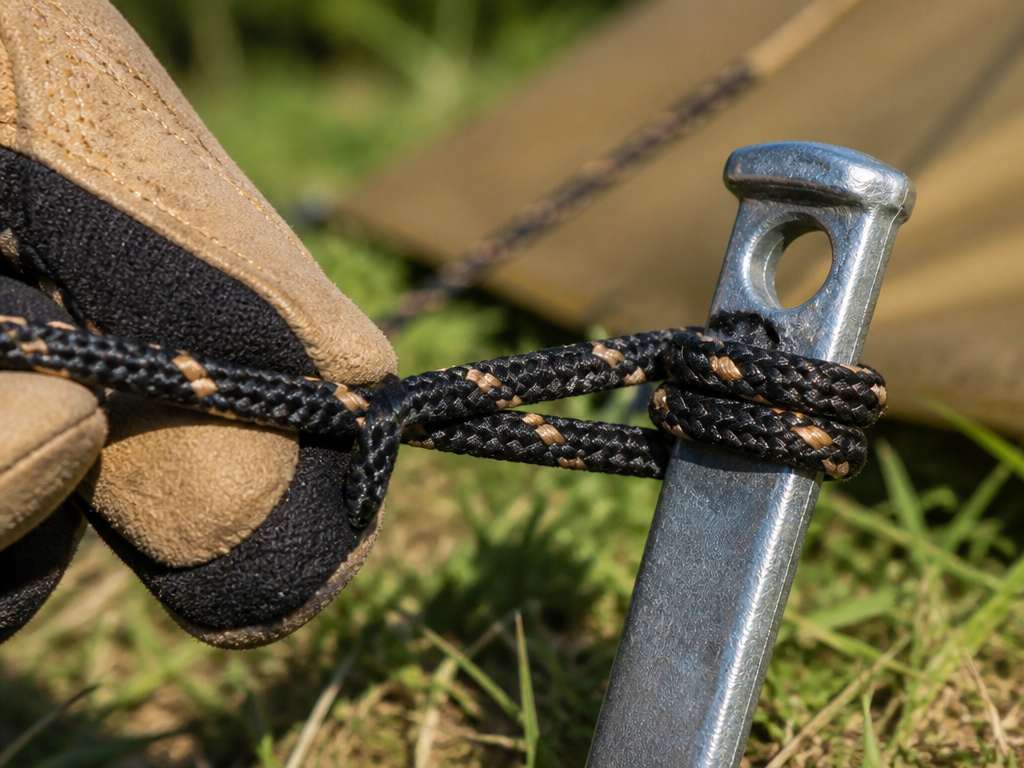
- Wrap towards the stake. Pass the working end around the stake. Bring it back and cross over the standing line (the part going back to the tent). Wrap the working end around the standing line twice, moving towards the stake. Keep these wraps neat and adjacent.
- The locking turn. Now bring the working end over to the side away from the stake. Wrap it around the standing line one more time to form a loop. Feed the working end back through that loop from underneath.
- Dress and set. Pull all parts of the knot snug against the stake. You should see two neat wraps on the stake-side and one locking loop on the tent-side. To tighten the guy line, slide the knot toward the tent. A firm tug on the standing line will lock it.
Skip the dressing step and the knot will bind unevenly. It might hold initially, but a shift in wind direction will cause it to cinch down on itself and become impossible to adjust. You’ll be untying it with a knife.
TL;DR: Wrap twice toward the stake, make a final loop away from the stake, feed the end back through, and pull everything tight against the stake before tensioning.
The Physics of a Stable Knot
A knot is just a way to connect a rope to a stake. Stability comes from how you orient the entire system. Get the angle or height wrong, and you turn a sturdy 10-inch stake into a decorative twig.
The Industrial Fabrics Association International (IFAI) handbook spells this out with engineering diagrams. For wind uplift, the ideal guy rope angle is 45 degrees. This creates a force vector that pushes the stake down into the ground as much as it tries to pull it sideways.
| Guy Rope Angle | Force on Stake | Likely Failure Mode |
|---|---|---|
| 30° or less (Shallow) | Mostly lateral pull | Stake rocks loose, plows out of ground |
| 45° (Ideal) | Balanced vertical & lateral | Stake resists uplift and pull-out |
| 60° or more (Steep) | Mostly vertical pull | Stake lifts straight up, especially in soft soil |
A shallow angle is the most common error in casual camping. It looks tidy, running straight out from the tent. In a 20-mph gust, that stake experiences pure sideways force. It pivots on its tip and levers itself out of the ground. You’ll find it lying three feet away after a storm.
The second rule is knot height. The IFAI states clearly: keep the attachment point on the stake as low as possible. Two to three inches above ground is the max.
Why? Physics again. The height of the knot creates a turning moment, or leverage, against the stake’s buried length. A knot tied at the top of a 12-inch stake has a huge mechanical advantage to rock the stake loose. A knot tied at the 2-inch mark minimizes that leverage, letting the soil do its job of holding the stake in place.
Common mistake: Tying the knot at the very top of the stake because it’s easier, this can reduce the stake’s holding capacity by half, according to the same engineering manual.
These principles apply whether you’re securing a family dome tent or a large canopy. For bigger shelters like stand-up tents or canvas tents, which present more surface area to the wind, getting the angle and height correct is non-negotiable.
TL;DR: A 45-degree rope angle balances forces. A knot lower than 3 inches off the ground prevents leverage. Both matter more than your stake’s material.
Rope Matters: Diameter and Material
You wouldn’t use sewing thread to tow a car. Don’t use paracord’s inner strands for your guy lines. The rope is a critical part of the system.
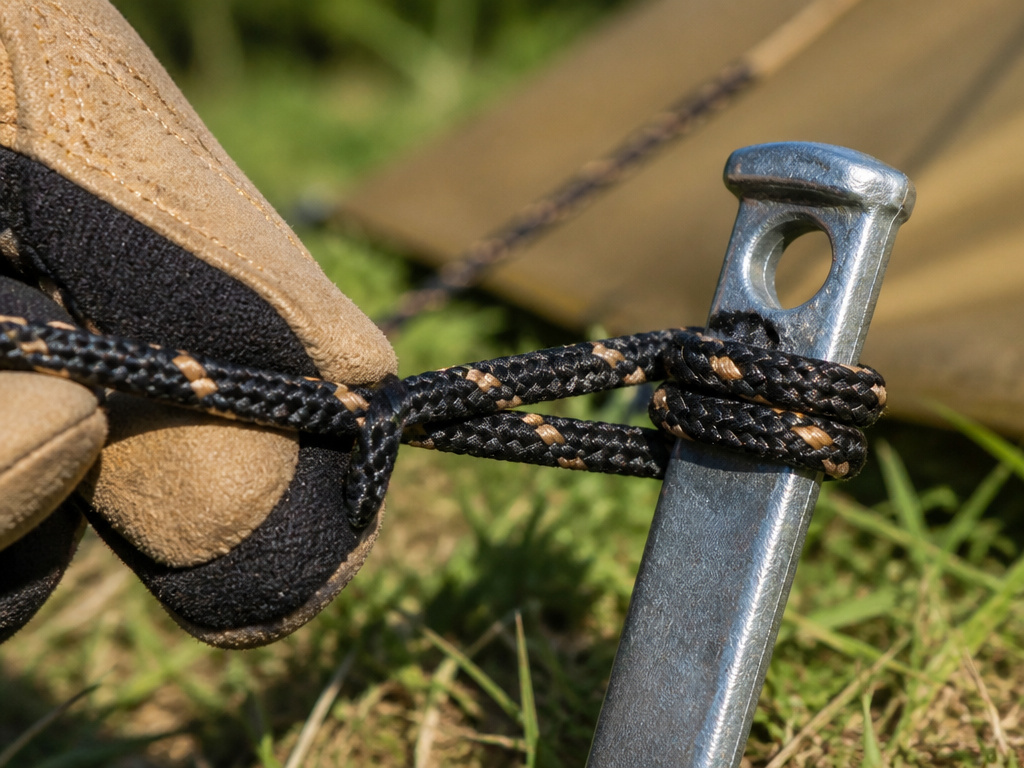
The research recommends a rope diameter of 4-6mm. This isn’t arbitrary. Rope in this range is thick enough to tie securely without cutting into itself, durable against UV and abrasion, and still easy to handle and knot. Thinner cord, like 2mm accessory cord, will slip in a taut-line hitch no matter how well you tie it. The pressure per square millimeter is too high, and the wraps melt together.
Nylon or polyester are the standard choices. Nylon has more stretch (which can be a shock absorber in gusts) but degrades faster in sunlight. Polyester has less stretch and better UV resistance. For most tent camping gear, a polyester-blend utility cord is the workhorse.
Before you start: Always wear gloves when tensioning guy lines. A rope under sudden tension can burn your hands if it slips. Inspect your stakes for bends or cracks; a compromised stake can snap under load and become a projectile.
The rope is your direct link to the tent’s structural integrity, especially for models marketed as high-wind tents or tents for heavy rain. A failure here isn’t just inconvenient; it can collapse a pole section or rip a fabric grommet.
When building your essential tent camping gear kit, don’t cheap out on cordage. Fifty feet of quality 5mm utility cord costs little and lasts for years. It’s also versatile for other campsite needs, from hanging a bear bag to making a repair.
When Your Knot Isn’t the Problem

Sometimes you do everything right, 45-degree angle, low knot, good rope, and the stake still creeps loose. The problem is likely underfoot.
Soil type is the great variable. The holding capacity of a tent stake changes dramatically with moisture and composition. A sand stake that holds in damp, compacted sand will pull straight out of dry, loose sand under the same tension. In clay, a stake can be rock-solid until a rainstorm lubricates the soil, turning it into a slick slide.
This is why a one-size-fits-all stake kit often fails. For hard ground, you need tough, angled stakes you can drive deep. For sand, you need long, wide-surface-area stakes or deadman anchors. The Virginia Tech staking pocket guide emphasizes assessing ground conditions as the first step in any installation.
Pavement or rocky sites require a completely different approach, often using weighted anchors or tie-offs to fixed objects. The principles of angle and knot height still apply, but the attachment point changes.
Common mistake: Using the same skinny, bent aluminum stakes on every trip, they’re fine for grassy parks but useless in the loose forest duff or beach sand where many car camping tents are pitched.
Your knot can only be as strong as the stake’s purchase in the earth. If you’re camping in variable or uncertain terrain, pack a mixed set of stakes. Include a few robust camping accessory recommendations like ground screws or heavy-duty plastic stakes for sand. Your taut-line hitch will work on all of them, but only if they’re planted in something that can hold.
Frequently Asked Questions
What is the simplest knot for a tent stake?
Two half hitches. Pass the rope around the stake, then tie two simple overhand knots around the standing line. It’s not adjustable, but it’s fast and secure for fair-weather camping. For any situation where wind or rain might slacken the lines, upgrade to the taut-line hitch.
Can I use a bungee cord instead of rope?
You can, but it changes the forces. A bungee (shock cord) provides give, which can reduce shock loading on stakes and tent points in gusts. However, you still need a static rope or cord to actually tie the taut-line hitch to the stake itself. Tie the hitch with rope, then use a carabiner or knot to connect that to a short bungee loop attached to the tent.
How tight should guy lines be?
Tight enough to remove slack, not so tight they distort the tent fabric or lift the stake. Lines should feel firm but still have a slight give. In polyester rope, you shouldn’t hear a high-pitched “twang”. Overtightening is a leading cause of pole breakage and seam stress, even on storm-resistant tents.
What if my stake has no hole for the rope?
Most modern tent stakes have a notch, hook, or hole. If yours is a simple rod, use the stake as the “post” for your taut-line hitch. The knot ties directly onto the stake itself. Just ensure the wraps sit below the top of the stake to keep the knot height low.
Do I need to re-tighten knots after it rains?
Yes. Rope shrinks slightly when wet and stretches as it dries. Fabric can relax. Always do a round of gentle re-tensioning on all guy lines a few hours after a rain shower or in the morning after a dewy night. This is the main advantage of the taut-line hitch, you can adjust it without untying.
The Bottom Line
Tying a tent stake knot is a three-part skill. The taut-line hitch is the mechanism. The 45-degree angle and low knot height are the positioning. The 4-6mm rope is the material. Miss one, and your stability drops by a factor.
This isn’t about passing a scout badge. It’s about sleeping through a midnight squall without your shelter collapsing around you. A well-tied, well-set guy line is the difference between a story about a cozy night in the rain and a miserable, soggy pack-out.
Invest ten minutes at home with a stick and some cord. Practice the wrap pattern until your fingers remember it. Your future dry, stable self will thank you.